
Site portrait
Colt Lyon
Lyon, 69 · operating
Independent observatory
Site grade
Csettled grade
Rated C on site, but D on “Water”.
This page says the same thing as the technical sheet, in the order of a decision to take: what weighs, what is missing, and what is still worth asking for while it can still be asked.
The five pillars behind the grade
- Energy 4 of 6 measures C
- Water 3 of 4 measures D
- Land & biodiversity 2 of 7 measures B
- Local impact 2 of 7 measures C
- Transparency & governance 0 of 2 measures –
A pillar with no letter rests on too few measures to defend one. We publish the count rather than a letter we could not stand behind.
The points that will decide
Energy
- Grid connection capacity / proximity : grid saturated at the connection point
- Local grid carbon intensity : 17.6 gCO2e/kWh
- Grid congestion / connection queue : little local grid congestion
To ask for : What PUE is announced, and measured how? to claim from the authority — the site is running, only its operating conditions still bite
Water
- Local water stress : high water stress
- Water body status : water body in moderate status
- Basin withdrawal pressure : moderate abstraction in the basin
To ask for : Which cooling technology, and how much water a year — in a basin already under stress? to claim from the authority — the site is running, only its operating conditions still bite
Land & biodiversity
- Overlap / distance to protected areas : protected natural area 1–5 km away
- Soil status (artificialized / natural / agricultural) : previously developed land
To ask for : What ground footprint, and on which parcels? to claim from the authority — the site is running, only its operating conditions still bite
What this looks like from the street
Noise — continuous, day and night
Cooling runs permanently and standby generators are tested on a schedule. What is regulated is not a distance but how far the noise rises at the neighbour's.
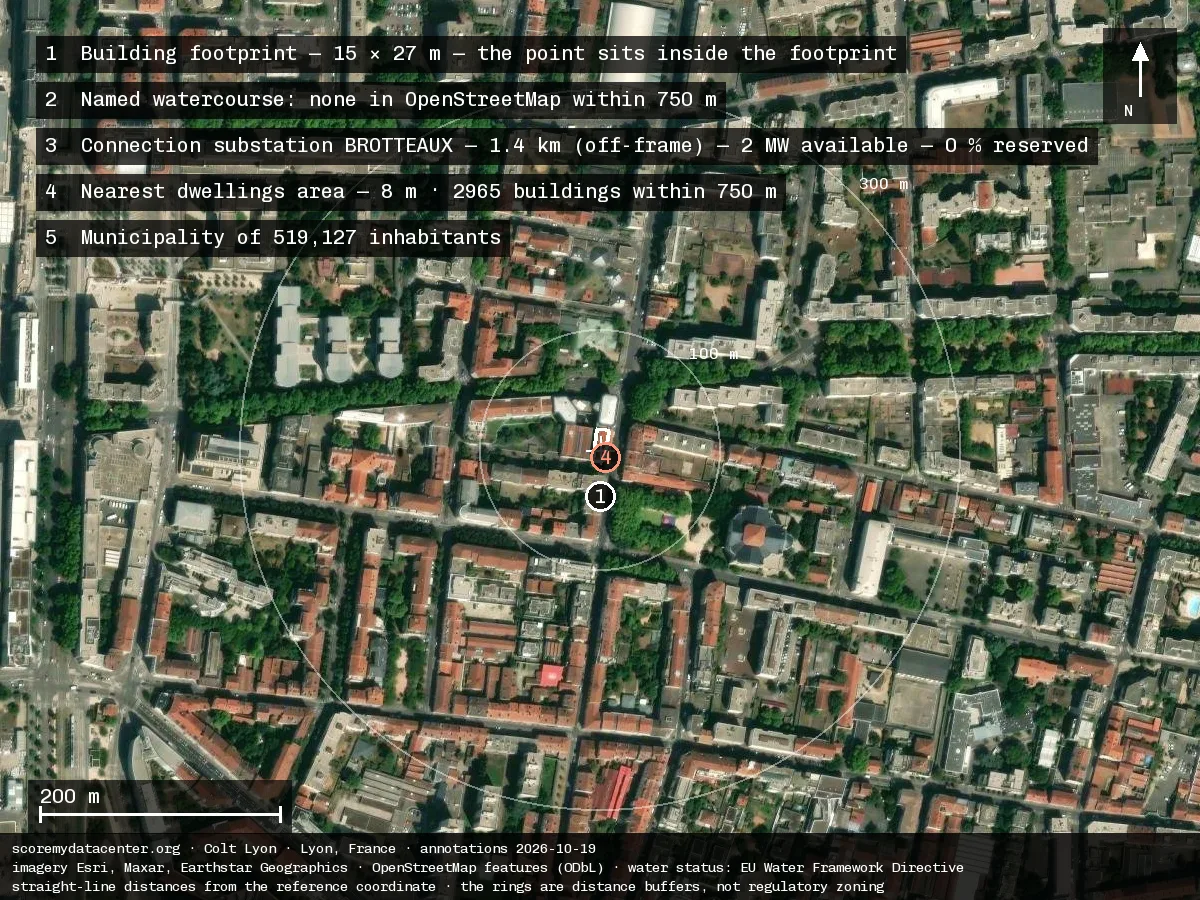
The nearest recorded dwelling is 4 m from the reference point. That is a straight-line distance, never a noise measurement: the acoustic study in the file is still to be demanded — it is the one that sets enforceable values.
Standby generators and their fuel
A facility like this keeps standby generators and the tanks that feed them. They are what gets tested, what gets smelled, and what triggers its own permitting. Their number, their fuel and the volume stored are in the file where one exists.
We measure no health effect and we do not claim to. We publish what is in the file, and what is not.
What we have not measured
- Ecological corridors (TVB)verified absent from the file we read
- Absorption capacity (project size vs municipality)verified absent from the file we read
- Observed level of oppositionverified absent from the file we read
- Elected officials' position (voted facts only)verified absent from the file we read
These gaps are ours, not the developer's: they say where our measurement stops, and they do not penalise the site.
Where the procedure stands
- announced
- under review
- under construction
- operating
the département préfet, after a public inquiry
The site is running: what remains is a claim to the préfet that the operating conditions are insufficient — noise, discharges, water.
Once authorised, third parties have two months from the posting and publication to appeal — and it does not come back.
The appeal must be notified to the issuing authority and to the beneficiary within fifteen days, or it is inadmissible.
Anyone who buys or rents after the authorisation is posted can no longer challenge the nuisances it allows.
The inquiry file — impact assessment, acoustic study, environmental authority opinion — is open at the town hall and online for the whole inquiry.
Code de l'environnement, art. R. 181-52 · Code de l'environnement, art. R. 181-50 (décret n° 2024-423 du 10 mai 2024) · Code de l'environnement, art. R. 181-51 · Code de l'environnement, art. L. 514-6, III · Code de l'environnement, art. L. 123-9
What to get written into the approval
- To ask for : What PUE is announced, and measured how? to claim from the authority — the site is running, only its operating conditions still bite
- To ask for : Will the waste heat be recovered, by whom, and from which phase? to claim from the authority — the site is running, only its operating conditions still bite
- To ask for : Which cooling technology, and how much water a year — in a basin already under stress? to claim from the authority — the site is running, only its operating conditions still bite
- To ask for : What ground footprint, and on which parcels? to claim from the authority — the site is running, only its operating conditions still bite
- To ask for : Which avoidance, reduction and offset measures? to claim from the authority — the site is running, only its operating conditions still bite
- To ask for : Is the land already designated for development in a supra-municipal plan? to claim from the authority — the site is running, only its operating conditions still bite
- To ask for : Does the planning document have to be changed for this project? to claim from the authority — the site is running, only its operating conditions still bite
- To ask for : How many permanent jobs after construction, and of what skill level? to claim from the authority — the site is running, only its operating conditions still bite
- To ask for : What tax revenue for the municipality, over what period, with what abatements? to claim from the authority — the site is running, only its operating conditions still bite
- To ask for : What consultation is planned, on what date, and who answers it? to claim from the authority — the site is running, only its operating conditions still bite
- To ask for : Is the full file open to consultation, where, and until when? to claim from the authority — the site is running, only its operating conditions still bite
Commitments that are not in the approval cannot be enforced: what is not written cannot be demanded later.