
Site portrait
STAMP Data Center
Genesee County, New York · Stream U.S. Data Centers · announced
Independent observatory
Site grade
Dprobable grade · window B–E
Rated D on site, but E on “Water”.
This page says the same thing as the technical sheet, in the order of a decision to take: what weighs, what is missing, and what is still worth asking for while it can still be asked.
The five pillars behind the grade
- Energy 2 of 6 measures E
- Water 2 of 4 measures E
- Land & biodiversity 2 of 7 measures B
- Local impact 1 of 7 measures ·
- Transparency & governance 0 of 2 measures –
A pillar with no letter rests on too few measures to defend one. We publish the count rather than a letter we could not stand behind.
The points that will decide
Water
- Local water stress : high water stress
- Water body status : water body in bad status
To ask for : Which cooling technology, and how much water a year — in a basin already under stress, into an already impaired watercourse? to ask now, before the application is filed
Energy
- Local grid carbon intensity : 109.8 gCO2e/kWh
- Grid congestion / connection queue : critical local grid congestion
To ask for : What PUE is announced, and measured how? to ask now, before the application is filed
Land & biodiversity
- Overlap / distance to protected areas : no protected natural area on record within 5 km, to our knowledge
- Soil status (artificialized / natural / agricultural) : previously developed land
To ask for : What ground footprint, and on which parcels? to ask now, before the application is filed
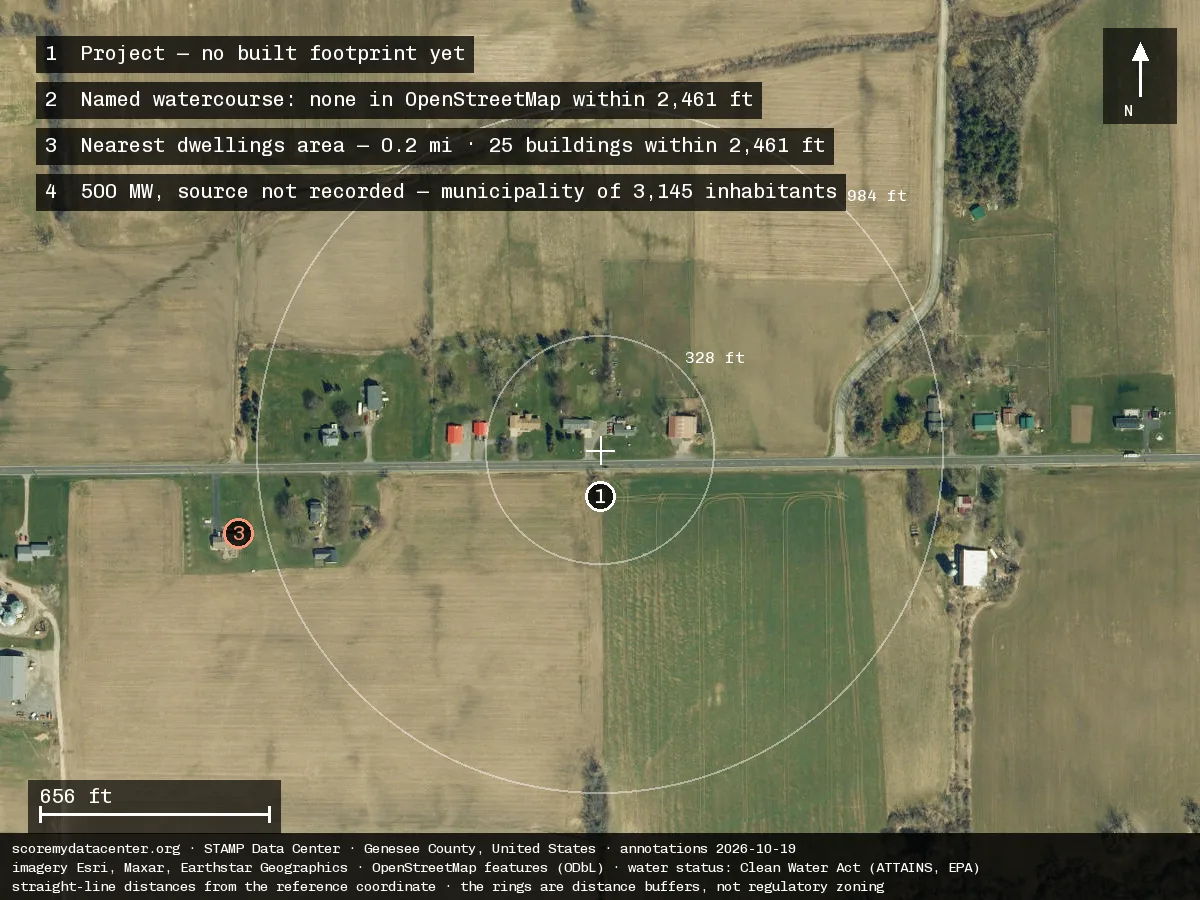
What this looks like from the street
Noise — continuous, day and night
Cooling runs permanently and standby generators are tested on a schedule. What is regulated is not a distance but how far the noise rises at the neighbour's.
We hold neither a nearest-dwelling distance nor an acoustic study for this site. Both are obtainable: the study is a document in the file.
Standby generators and their fuel
A facility like this keeps standby generators and the tanks that feed them. They are what gets tested, what gets smelled, and what triggers its own permitting. Their number, their fuel and the volume stored are in the file where one exists.
We measure no health effect and we do not claim to. We publish what is in the file, and what is not.
What we have not measured
- Grid connection capacity / proximitynot yet collected by us
- Heat-network connectabilityverified absent from the file we read
- Basin withdrawal pressurenot yet collected by us
- Ecological corridors (TVB)verified absent from the file we read
- Municipality socio-economic profilenot yet collected by us
- Technological hazard / nearby Seveso sitesnot yet collected by us
- Observed level of oppositionverified absent from the file we read
- Elected officials' position (voted facts only)verified absent from the file we read
These gaps are ours, not the developer's: they say where our measurement stops, and they do not penalise the site.
Where the procedure stands
- announced
- under review
- under construction
- operating
the town or county that zones the land (lead agency under SEQRA)
Before any filing: financial assistance from an industrial development agency (property-tax abatement, PILOT) above $100,000 requires a public hearing — often the project's first public meeting, and the earliest.
If a public hearing is held on the draft EIS, it opens no less than 15 and no more than 60 calendar days after the notice of completion is filed: the date is watched for, not requested.
The industrial development agency's hearing must be noticed at least ten days ahead: that is the minimum warning you get.
Challenging the decision in court (an Article 78 proceeding): four months from the day it becomes final and binding. This one does not come back.
Any record held by the town, the county or the development agency — impact study, assistance application, acoustic study — is obtained by a written FOIL request: the agency must act within five business days.
A denial can be contested: thirty days to appeal in writing to the agency's designated appeals officer.
N.Y. General Municipal Law § 859-a(2) · 6 NYCRR 617.9(a)(4)(ii) · N.Y. General Municipal Law § 859-a(3) · N.Y. CPLR 217(1) · N.Y. Public Officers Law § 89(3)(a) · N.Y. Public Officers Law § 89(4)(a)
What to get written into the approval
- To ask for : Which cooling technology, and how much water a year — in a basin already under stress, into an already impaired watercourse? to ask now, before the application is filed
- To ask for : What PUE is announced, and measured how? to ask now, before the application is filed
- To ask for : Will the waste heat be recovered, by whom, and from which phase? to ask now, before the application is filed
- To ask for : What ground footprint, and on which parcels? to ask now, before the application is filed
- To ask for : Which avoidance, reduction and offset measures? to ask now, before the application is filed
- To ask for : Is the land already designated for development in a supra-municipal plan? to ask now, before the application is filed
- To ask for : Does the planning document have to be changed for this project? to ask now, before the application is filed
- To ask for : How many permanent jobs after construction, and of what skill level? to ask now, before the application is filed
- To ask for : What tax revenue for the municipality, over what period, with what abatements — for a municipality the project dwarfs? to ask now, before the application is filed
- To ask for : What consultation is planned, on what date, and who answers it? to ask now, before the application is filed
- To ask for : Is the full file open to consultation, where, and until when? to ask now, before the application is filed
Commitments that are not in the approval cannot be enforced: what is not written cannot be demanded later.